Fort Cherry School Board meeting, May 23, 2011:
The board adopts the following resolution, resulting in the furlough of truthfully and legally certified teachers:
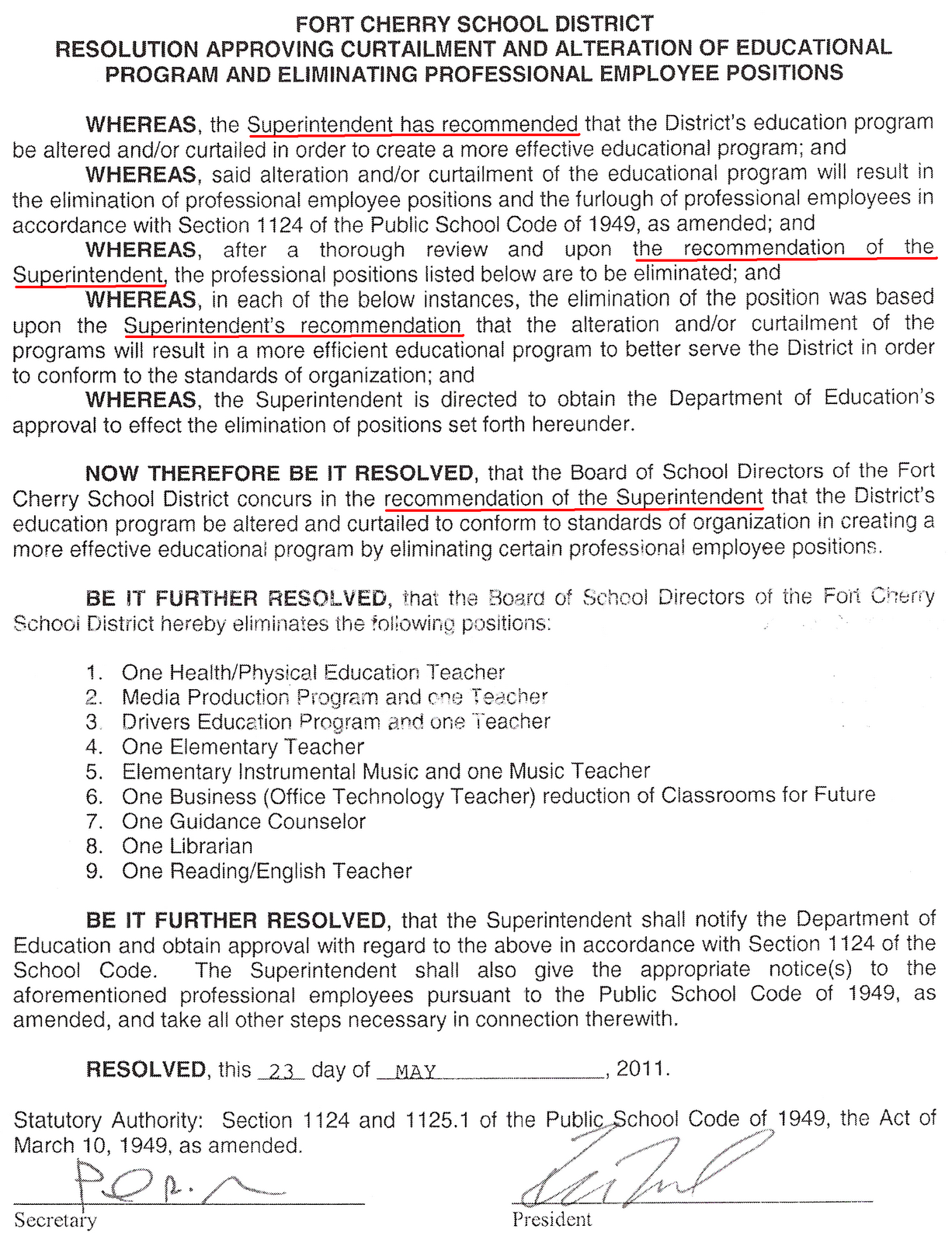
Superintendent Dinnen recommended the adoption of this resolution.
With the exception of Chris Lauff, the Board followed Dinnen’s recommendation without question.
The vote to adopt was 8 to 1:
McDonald board reps: Brant Miller: Yes
Ray Miller: Yes
Elmo Cecchetti: Yes
Robinson board reps: Beverly Schwab: Yes
Larry Heinrendt: Yes
Mike Duran: Yes
Mt. Pleasant board reps: Bruce Sharpnack: Yes
Jamie White: Yes
Chris Lauff: NO
At the time the resolution was approved, the board was fully aware of questions surrounding Dinnen’s certification and his misstatement of fact regarding his teaching experience on his resume.
Shouldn’t Dinnen’s initial misstatement of fact about himself make the board wary of everything he presents to them?
The Board’s failure to address his misstatements and continued support of Dinnen's recommendations appears to violate school policy:
“Any candidate's misstatement of fact material to qualifications for employment or
the determination of salary shall be considered by this Board to constitute grounds for dismissal.”
FC District Policy #302
EMPLOYMENT OF SUPERINTENDENT/
ASSISTANT SUPERINTENDENT
ADOPTED: March 27, 1995
Yet, the Board followed his advice and approved the furlough of dedicated teachers and vital programs.
The board is fully aware of Dinnen’s misstatement of fact.
The administration, with their bloated salaries, bonuses, and travel perks remains intact. (As recently as this past June, after furloughing good teachers and programs, three administrators travelled to Philadelphia – the associated expense reimbursements totaled $7500.00.)
As promised in the June 17th post, the documentation showing the facts behind the beginning of Dinnen’s tenure and the end of truth, honor, and integrity at Fort Cherry continues. . .
The Fort Cherry School Board interviewed Dinnen in May of 1998, and hired him as the Substitute Superintendent effective July 1, 1998.
During his interview, Dinnen presented himself to the Board as a fully certified superintendent.
Dinnen did not divulge the following facts to the Fort Cherry School Board during his application process:
1. Dinnen’s 1996 Letter of Eligibility and superintendent certificate were annulled by Secretary of Education, Eugene Hickok, in his March 1998 adjudication.
2. Dinnen was unable to be commissioned as a superintendent due to the questions about his certification and the subsequent annulment of his Letter of Eligibility.
3. Dinnen’s certification was under appeal.
As established in an earlier post, no one (including Fort Cherry) verified Dinnen's claims of professional and administrative services at Mattoon School District.
Did anyone from Fort Cherry contact New Brighton?
If they did, would they have been told anything negative about him?
Dinnen’s settlement with New Brighton included a clause that forbid derogatory comments against Dinnen and also guaranteed him a positive reference from the district. . . .


The Fort Cherry School Board approved Dinnen as the Substitute Superintendent in June of 1998.
Unknown to the board, on June 3, 1998, Dinnen travelled to Harrisburg to appear before the PDE’s Certification Appeal Committee to appeal the annulment of his letter of eligibility and superintendent certificate.
As he testified previously in his lawsuit against the PDE, Dinnen once again swears that he taught high school students in the Mattoon JROTC program.
(Testimony from the Hearing Transcript Re: The Appeal of Robert Dinnen before the Certification Appeal Committee, Wednesday, June 3, 1998)


Mattoon denies Dinnen’s claims.
Did the PDE’s Certification Appeal Committee contact Mattoon to verify Dinnen’s statements?
It seems impossible, considering private citizens' recent inquiries to Mattoon produced an emphatic “no” to Dinnen’s claims of employment and administrative oversight.
(The response from Lt. Col. Yelk, shown below, are from a letter received from Mattoon in response to a Freedom of Information Request – the entire document can be found on post dated Friday, June 10th: http://fortcherryinfo.blogspot.com/2011/06/pdes-clerical-error-part-6-teaching-by.html)


At the conclusion of the appeal hearing, the Certification Appeal Committee made its recommendation to Secretary of Education Hickok who would issue a final decision.

Although normal turnaround time for a decision was six to eight weeks, the final decision would take several months.
Meanwhile, Dinnen settled in at Fort Cherry.
October 27, 1998: A decision is reached in the appeal.
Hickok denied Dinnen’s appeal.


Hickok gave Dinnen credit for 5 years and 11 months of experienced in the “basic schools”, which included:
· 2 years - Mattoon JROTC
· 1 year and 6 months - Indiana Department of Education.

On page 3 Hickok gave Dinnen credit for 2 years of experience “. . . based upon their examination of your work with the Junior ROTC program”.

Who examined Dinnen’s work and did they contact Mattoon?
It has been established that Mattoon will not verify Dinnen’s claims of administrative oversight and professional services with the Mattoon JROTC students. In fact they vehemently deny his involvement beyond Dinnen showing up for formal JROTC inspections, occasional field exercise activities and annual recruitment day activities.
What about time spent at the Indiana Department of Education?
Dinnen was NOT employed by the Indiana Department of Education.
He was employed at the Indiana Commission for Higher Education, an entity that did not deal with education in the basic schools and was not associated with the Indiana Department of Education.
Why would Hickok credit Dinnen for time at the Indiana Department of Education when Dinnen actually worked at the Indiana Commission for Higher Education?
Was it an innocent mistake, a typographical error?
In this September 5, 1997, testimony, Dinnen described his duties and responsibilities as the assistant director of fiscal affairs for the Indiana Commission of Higher Education.
(Testimony from Office of Postsecondary Higher Education, Petitioner, vs. Robert W. Dinnen, Respondent, Docket No. 1997-1, Friday, September 5, 1997)


Remember, Dinnen needed to establish a connection to the basic schools.
There doesn’t appear to be a connection to basic schools in Dinnen’s major responsibilities with the commission.
But, Dinnen continues:

So, there it is - “Links and partnerships with K through 12, more specifically high school. . .”
Dinnen continues on, citing his “experience and background in working with high school students”.
Would this be the experience at Mattoon? Experience that Matton denies?


Dinnen continues to link his experience with the Indiania Commission of Higher Education to basic schools:


Dinnen states that his role as a “tangential part of the plan from the fiscal side, providing data” in a study done in conjunction with the Department of Education gave him experience in the basic schools.
It appears Hickok agreed.
It appears Hickok took the “tangential” piece of testimony and credited Dinnen for experience with the “Indiana Department of Education” instead of the “Indiana Commission of Higher Education”.
Was this a deliberate attempt by Hickok to bolster Dinnen’s experience in the basic schools?
Possibly.
In the September 5, 1997, testimony Dinnen’s lawyer established that the PDE had accepted work done for the Department of Education as an acceptable substitute for experience in the basic schools. Here, Dinnen’s attorney questions Donald Lunday, Director of the Bureau of Teacher Preparation and Certification, who verifies that work done for the Department of Education qualifies.

Hickok repeats Lunday’s statement on page 3 of his letter:

According to the PDE, experience with a Department of Education can be credited toward a Letter of Eligibility.
Following Hickok's logic, Dinnen, an accountant, whose job title was “assistant director of fiscal affairs” for the Indiana Commission of Higher Education, was credited for basic schools experience with the Indiana Department of Education because he provided financial data for a study.
By Hickok's calculations, Dinnen was still one month shy of the six years of required experience.
By Hickok's calculations, Dinnen was still one month shy of the six years of required experience.
Hickok had to deny the appeal.

How did Dinnen remain at Fort Cherry as substitute superintendent without his Letter of Eligibility and Superintendent Certificate?
Surely the Board would learn that his certification was annulled and he wasn’t commissioned.
You would think that, but. . .
Fort Cherry had recently hired a new business manager, Bill McNamee.
McNamee was also board secretary.
McNamee’s experience was in banking, not school business.
Almost one month to the day from the date of Hickok’s letter requiring Dinnen to accumulate one more month of experience in K-12, a letter was submitted to the PDE, signed “William M. McNamee, Board Secretary”.
The letter gave Dinnen the one month of service he needed in the basic schools, courtesy of Fort Cherry School District, exactly as Hickok ordered.
Let’s take a look at McNamee’s letter:

· This letter is dated November 30, 1998, the Monday after Thanksgiving. Fort Cherry School District is closed for Thanksgiving break on the Monday after Thanksgiving. Did McNamee go in to work on his day off to compose, sign, and mail this letter?
· The letter was addressed “To Whom It May Concern”. Was this an attempt to keep McNamee from knowing the recipient of the letter? Surely he would have questioned a letter going to the Secretary of Education.
· The letter was signed by McNamee in his capacity as board secretary, but the school board did not authorize this letter.
· The next board meeting was scheduled in December. The letter was not included in the Secretary’s Correspondence from that meeting, or any future board meeting. The school board did not see the letter.
· In the letter, Dinnen’s job performance was evaluated as satisfactory, but the school board was not aware of any evaluation.
McNamee was contacted in regards to this letter. McNamee said that he never would have known how to write or type a letter in that format, not with his banking background. He would have either had a similar letter provided to him to copy or had the finished letter put in front of him to sign.
The letter went out without the board’s knowledge or approval.
This was confirmed by the Board President, Vice-President, and Treasurer of the 1998 board.
Why go behind the board’s back?
· At this point Dinnen was unable to be commissioned as a superintendent because he did not have a valid Letter of Eligibility.
· The board was unaware that he lacked his commission.
· Dinnen was working at Fort Cherry as a substitute superintendent. Legally, only a fully commissioned superintendent is permitted to be a substitute superintendent. Dinnen, without a commission, was only permitted to be an acting superintendent. Acting superintendents are permitted to remain on the job for only one year.
· Dinnen started working at Fort Cherry July 1, 1998. Dinnen had six months to obtain his commission.
Without the board’s knowledge or approval, Dinnen had in his possession a letter giving him one month of experience in K-12. But, the letter itself was not enough to put the “Bureau in a position to issue a Letter of Eligibility”; Hickok also said that Dinnen must reapply.
Let’s take a look at the applications the PDE has in its possession.
Keep in mind that PDE regulations for the submittal of applications require original signatures, no older than 1 year from the date of the application.
Here’s Dinnen’s 1998 application, stamped received by the PDE December 2, 1998:


Let’s compare this to Dinnen’s 1996 application, stamped received by the PDE October 28, 1996:


When you compare his 1996 application to the 1998 submission, it appears that the 1996 application was copied and resubmitted.
Comparing 1996 to 1998:
· 1998 Box #1: It appears Dinnen’s name was written over with a sharpie marker perhaps to make the 1998 application appear to be new.
· 1998 Box #3: This box should be checked “yes”. In February 1998 Dinnen was issued a PA teaching certificate for accounting.
· 1998 Box #4: This box should be checked “yes”. Dinnen’s Letter of Eligibility and certificate had been annulled. Given that he lost his appeal, it was still annulled.
· 1998 Box #7: Dinnen’s signature is dated “9/9/96”, exactly as it was dated in the 1996 application. In addition, his work phone number is listed as the number for New Brighton. Dinnen resigned from New Brighton effective June 30, 1998
· 1998 Box #8: Again, a 1996 date on the signature of the examining physician.
· 1998 Side 2, “PDE Control Number”: upon close inspection it appears that correction fluid was brushed over the original PDE Control Number so that a new Control Number could be stamped in its place.
· 1998 Side 2, “PDE Use Only”: the “Date Issued” block was written over with a black sharpie marker, right over the original date.
· 1998 Side 2, the 1998 application is stamped “RECEIVED” October 21 and 28, 1996, as well as December 2, 1998. (Perhap it was too difficult to “white-out” the original PDE received stamps?)
If PDE regulations for the submittal of applications require original signatures, no older than 1 year from the date of the application, then surely the PDE did not allow this to be processed. . .
The PDE appears to have accepted the application.
Dinnen’s application was stamped received December 2, 1998, by the PDE.
(This letter was acquired through a right-to-know request submitted to the PDE.)

Let’s compare the 1998 Letter of Eligibility to the annulled letter from 1996.
(This letter was also acquired through a right-to-know requested submitted to the PDE.)


This is strange. . .
The 1998 letter is an exact word-for-word duplicate of the 1996 letter.
Comparing the signatures, Ms. Kendall’s signatures appear to be different.
1996 (Ms. Kendall’s signature):

1998 (signed by Ms. Kendall?????):

Those two signatures do not appear to be the same.
Is it possible that Ms. Kendall’s handwriting style changed???
The answer to that is “NO”.
Here is a sample of Ms. Kendall’s handwriting from July 2010. She writes the letter “c” the same as she did in 1996.


Is it possible that the PDE would have just copied the 1996 Letter of Eligibility and changed the date?
According to Ms. Kendall, the answer to that is “NO”.
When Ms. Kendall was contacted about the two letters, she said that since Dinnen had filed a lawsuit against the PDE, the 1998 Letter of Eligibility would not have been signed by her.
The 1998 letter would have been composed and signed by someone at a higher level, most likely her boss and someone from the legal department.
In addition, Ms. Kendall said that the PDE did not issue “form letters” when issuing Letters of Eligibility.
The December 1998 letter would not have been a word-for-word duplicate. In fact, Ms. Kendall said it would have provided details of the previous letter issued to Dinnen and the events leading up to the issuance of the new letter.
If Ms. Kendall did not compose or sign the December 7, 1998, letter, who did?
Let’s compare the 1998 Letter of Eligibility that the PDE provided to the Letter of Eligibility that Fort Cherry has on file.
(This letter was acquired through a right-to-know request submitted to Fort Cherry.)

This is strange. . .
This letter provided by Fort Cherry appears to be different from the letter provided by the PDE.
Here again is the letter the PDE has on file.
These letters should be exactly the same.
They should be exactly the same, but they do not appear to be. Compare the signatures:
1998 from PDE:
1998 from FC:

Look at how far the loop in the “K” extends over Ms. Kendall’s first name on the first signature as compared to the second.
The two signatures do not appear to match.
Could the PDE have issued Dinnen another “original” Letter of Eligibility, perhaps due to loss or theft?
According to Ms. Kendall, the answer to that is “NO”.

There appears to be two versions of the December 1998 letter.
This is very strange.
To add to the mystery surrounding the letters of eligibility, originally, when the right-to-know request was submitted to the PDE for the 1998 Letter of Eligibility, the PDE could not produce it.
According to Ms. Kendall, if the letter had been produced according to PDE procedure, a copy would have been placed in Dinnen’s file located in the Bureau of Teacher Preparation and Certification, a file which by now would have been archived.
The 1998 letter was not in Dinnen’s archived file.
It was only after a subsequent right-to-know request was made to the PDE asking for a search of the PDE Legal Department files that the 1998 letter was produced.
Where did that 1998 letter come from and who produced it?
To review:
· A letter signed by the board secretary, Bill McNamee, evaluating Dinnen and giving him the credit for one month of K-12 experience was submitted to the PDE.
o The evaluation was done without the board’s knowledge.
o The letter went out without the board’s approval or knowledge.
· Dinnen submitted an application to the PDE without original or timely signatures.
· Dinnen’s Letter of Eligibility issued in response to the application is . . strange?. . . questionable?. . fraudulent?
Moving on. . .
Remember, Dinnen’s time was running out of time at Fort Cherry. He was not commissioned, yet was working as a “substitute superintendent”.
If the Board found out, he would be reduced to “acting superintendent” and would only be allowed to remain at Fort Cherry until the end of June 1999.
If the auditors found out, the District could face a loss of state subsidy money.
In addition there’s District Policy 302 which states that misstatement of fact is immediate grounds for dismissal.
But, the Board was unaware.
The Board hired Dinnen as Superintendent at the February 1999 board meeting.
Dinnen was one step closer to getting his commission. . .
· He had a “Letter of Eligibility”, which had to be attached to his commission application.
· The board approved him as superintendent, also required for a commission.
· Now all he had to do was swear under oath that he had completed all requirements for the position of superintendent and he would be commissioned.
Here’s Dinnen’s application for his Superintendent’s Commission:

Let’s compare McNamee’s signature on the commission application to his signature from the November 30th “to whom it may concern” letter.
This is strange. . .
McNamee’s signatures do not appear to be the same.
From the commission application:

From the November 30th letter:

The signatures on the November 30th McNamee letter and Ms. Kendall's signatures from the 1998 Letters of Eligibility appear . . .strange?. . . questionable?. . fraudulent?
Ms. Kendall’s true signature:

Questionable signatures:


McNamee’s true signature:

Questionable signature:

Let’s go back to the 1998 Letters of Eligibility.
· Is it possible that the PDE did not accept Dinnen’s 1998 application for his Letter of Eligibility and subsequently did not issue a new Letter of Eligibility to him?
· Is it possible that the 1998 Letter of Eligibility was not produced by anyone at the PDE, but was in fact created by someone to attach to the commission application - the commission that was necessary to remain as substitute superintendent?
· Is it possible that the PDE never verified the authenticity of the 1998 Letter of Eligibility that was attached to the commission application?
· Is it possible that the only reason the PDE has the 1998 Letter of Eligibility in its possession is because it was attached to the commission application that Dinnen submitted to the PDE in February 1999?
The board is aware of the serious questions surrounding the superintendent’s certification.
The board is aware of Dinnen’s misstatement of fact regarding his K-12 experience.
The board is aware of Dinnen’s misstatement of fact regarding his K-12 experience.
Board members Ray Miller and Brant Miller were personally handed documentation confirming these facts.
It is the board’s duty to ensure that the district employs legally and truthfully certified employees.
The parents, children, and taxpayers of this school district deserve nothing less.
Yet, the board, upon Dinnen’s recommendation, approved the furlough of legally and truthfully certified teachers, while leaving the administration intact.
It’s time to start repairing the damage done to Fort Cherry in the last 13 years.
We can start by electing new board members who will not blindly follow the superintendent's recommendations.


